Estimated read time: 11 minutes | Category: Urban Legends | Last updated: June 2025
The Bridge Where Dogs Jump
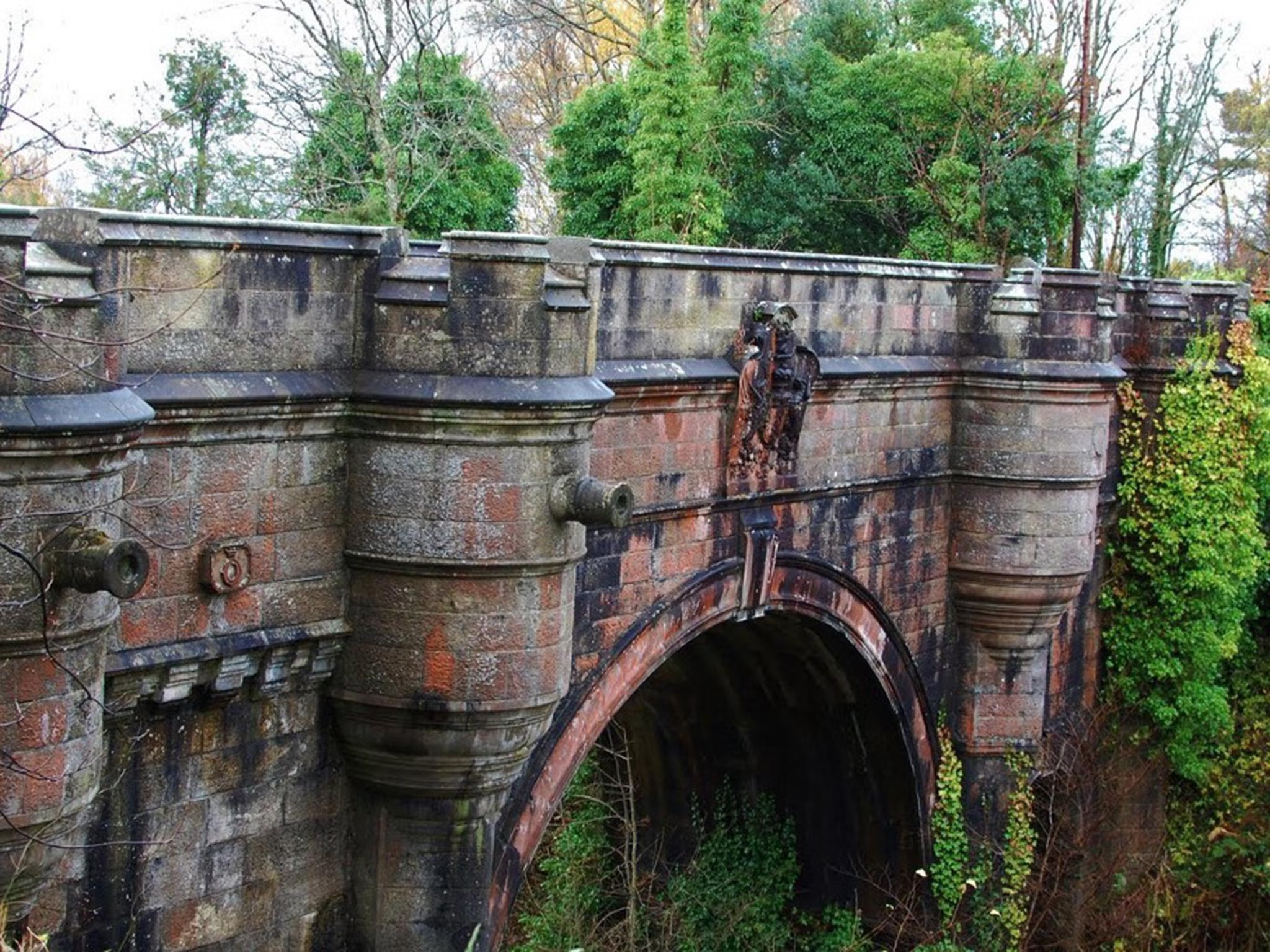
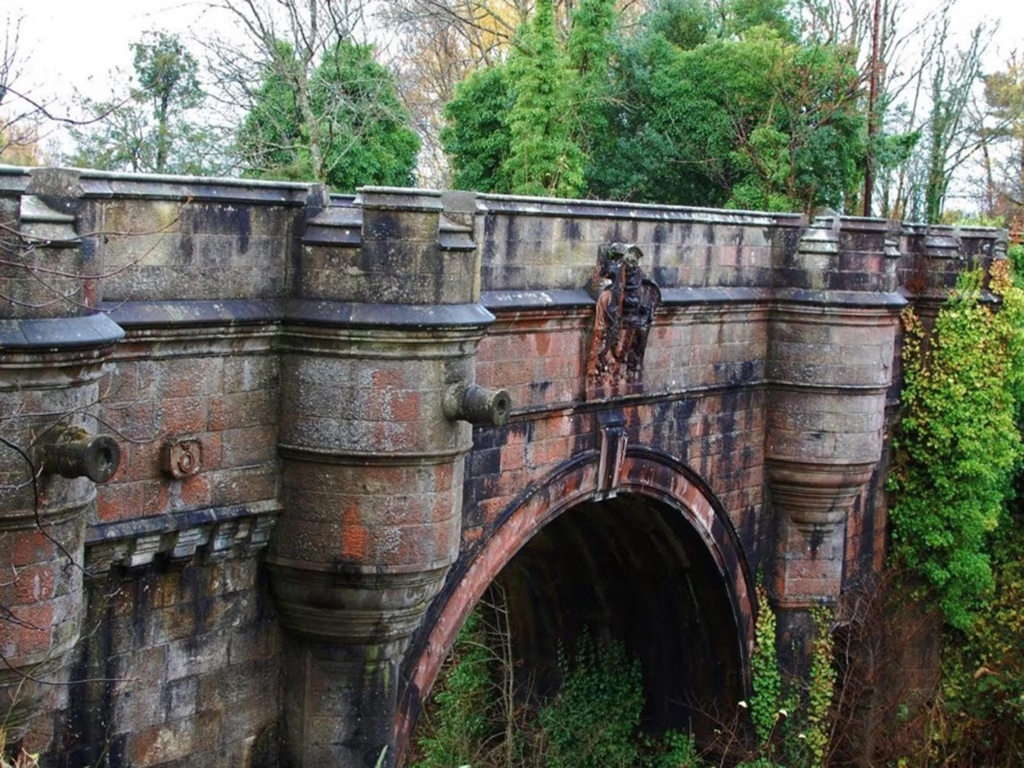
Overtoun Bridge is not, by any obvious measure, a remarkable structure. It is a stone arch bridge built in 1895, spanning the Overtoun Burn — a small stream — on the approach to Overtoun House near Dumbarton, Scotland. It is approximately 15 metres above the rocky burn below. It is surrounded by mature trees, within earshot of birdsong, in a quiet corner of the West of Scotland that most people outside Dumbarton have never heard of.
Since the 1950s, dogs have been leaping from it.
Not from anywhere on the bridge. From the same spot — specifically, the parapet at the right-hand side looking toward the house, at approximately the same location each time. Dogs walk across the bridge normally, then suddenly accelerate toward that specific section of parapet and leap over the edge — falling 15 metres to the rocks and water of the Overtoun Burn below.
Some have died. Some have survived, been rushed to veterinary care, recovered — and, when walked across the bridge again, immediately jumped a second time.
The phenomenon has been reported for decades. It has been investigated by animal behaviourists, journalists, and researchers. It has been filmed. It has attracted worldwide media attention and generated theories ranging from the scientifically grounded to the supernatural. And it remains, in the strictest sense, unexplained — no single theory has been universally accepted as the definitive cause.
Here is everything we know.
What We Know For Certain
- [FACT] Overtoun Bridge, built in 1895, spans the Overtoun Burn near Dumbarton, West Dunbartonshire, Scotland, on the approach to Overtoun House — a Victorian baronial mansion.
- [FACT] Multiple dogs have jumped from the bridge since reports began in the 1950s and 1960s. Estimates of the total number of incidents range from 50 to over 600, though the higher figures are difficult to verify and may conflate incidents of varying severity.
- [FACT] The jumps consistently occur from approximately the same location on the bridge — the right-hand parapet looking toward Overtoun House, at a spot where the bridge’s solid stone walls give way to a lower section with gaps that allow dogs to see or smell what is below.
- [FACT] The incidents appear to be significantly more common in clear, dry weather than in rain or fog.
- [FACT] The breeds most frequently reported as jumping are long-nosed breeds — Labradors, Retrievers, Collies, and Spaniels — rather than short-nosed breeds.
- [FACT] Animal behaviourist Dr David Sands investigated the bridge in 2006 for a BBC documentary and identified the scent of mink, introduced to the area in the 1950s, as a possible explanation — concluding that dogs were leaping after the scent without being able to perceive the drop through the dense vegetation below.
- [FACT] No other bridge or structure in the immediate area has been associated with similar incidents.
The History of the Phenomenon
[FACT] The earliest well-documented reports of dogs jumping from Overtoun Bridge date to the 1950s and 1960s. Local residents in Dumbarton and the surrounding area became aware of the pattern gradually — several incidents occurring over years rather than a single sudden cluster.
[FACT] The bridge attracted wider attention after newspaper coverage in the late 1990s and early 2000s began to use the phrase “dog suicide bridge” — a framing that, while journalistically compelling, is scientifically inaccurate. Animals do not commit suicide in the sense of deliberately ending their lives with an understanding of death. The phrase, however, stuck and became the primary way the phenomenon was described in popular media worldwide.
[FACT] A 2006 BBC documentary investigation brought the story to an international audience and prompted the most systematic attempt to date to explain the phenomenon scientifically. The documentary featured Dr David Sands’s investigation and attracted significant scientific and public commentary.
[FACT] A darker chapter in the bridge’s history occurred in 1994, when a local man threw his infant son from the bridge, believing he was the Antichrist, before jumping himself. Both survived. This incident — unrelated to the dog jumping phenomenon — has been conflated with it in some popular accounts, adding a layer of human tragedy to the location’s unusual reputation.
The Scent Theory — The Leading Scientific Explanation
The most widely accepted scientific explanation for the Overtoun Bridge phenomenon centres on scent — specifically the scent of animals that inhabit the Overtoun Burn below the bridge.
Dr David Sands’s 2006 investigation identified the presence of mink, mice, and other small mammals in the vegetation below the specific section of the bridge associated with the jumps. American mink were introduced to Scotland in the 1950s — the same decade the incidents began — and have established populations along many Scottish waterways including the Overtoun Burn.
[FACT] Mink produce a powerful musky scent that dogs — particularly hunting breeds with strong prey drives, such as Labradors, Retrievers, Spaniels, and Collies — find intensely stimulating. The scent can trigger a dog’s instinctive prey drive, causing them to follow it intently without regard for other stimuli.
[FACT] At the specific section of the bridge where jumps occur, the stone parapet is low enough that a dog moving at speed could easily go over it, and dense vegetation below obscures the drop from a dog’s perspective. A dog following an intense scent, focused on the smell rather than the visual environment, might not perceive the edge until it is too late.
[THEORY] This explanation accounts for several key features of the phenomenon: the consistency of location (where mink scent is strongest or most accessible through the parapet gaps), the breed pattern (hunting breeds with strong prey drives), the weather pattern (scent disperses more readily in rain; dry clear days allow scent to concentrate), and the repeat jumping (a surviving dog, returned to the bridge, would encounter the same scent stimulus).
Testing the Scent Theory
[FACT] Dr Sands conducted a basic experiment during the 2006 investigation: he applied the scent of various animals found below the bridge — mink, squirrel, rabbit, and others — to the pavement near the bridge and observed dogs’ reactions. Dogs showed significantly stronger interest in the mink scent than in other scents, consistently moving toward it and showing signs of intense arousal.
[FACT] The experiment was not conducted on the bridge itself and did not replicate the full conditions of the incident. It provided suggestive rather than conclusive evidence. The scent theory remains the most scientifically grounded explanation but has not been definitively confirmed through controlled study.
[ANALYSIS] One challenge to the pure scent theory is explaining why all dogs that cross the bridge do not jump — if mink scent is present at the specific location, it should stimulate all dogs with prey drive. Local dog owners and regular bridge users report that most dogs cross without incident. Possible explanations include variation in individual dogs’ prey drive intensity, variation in the strength of the scent on different days, and the specific combination of factors that produces a jump (speed, approach angle, distraction level) occurring only intermittently.
The Supernatural and Paranormal Theories
Overtoun Bridge has been associated with supernatural explanations since the phenomenon became widely known — partly because of the bridge’s Victorian Gothic aesthetic and partly because of the location’s general atmosphere.
Celtic spiritual tradition identifies certain locations as “thin places” — spots where the boundary between the physical world and the spiritual realm is unusually permeable, and where supernatural forces are particularly active. Overtoun Bridge has been described by some as a thin place, with the suggestion that dogs — being more spiritually attuned than humans — are responding to a supernatural presence that humans cannot perceive. [SPECULATION] There is no scientific evidence for thin places or supernatural influences on animal behaviour. This explanation is included because it is part of the cultural discourse around the bridge and reflects genuine local belief, not because it has evidential support.
Overtoun House — the Victorian mansion the bridge approaches — has its own ghost stories, most commonly involving the “White Lady of Overtoun” said to be the spirit of Lady White, a former resident who appears at windows and in the grounds. Some accounts link the dog jumping phenomenon to this apparition, suggesting dogs are reacting to a ghostly presence imperceptible to humans. [SPECULATION] No credible evidence connects the ghost stories to the dog jumping incidents. The White Lady tradition predates the documented jumping phenomenon and appears to be a separate folk belief.
Some researchers and commentators have proposed that unusual electromagnetic fields or geophysical features at the bridge location could affect animal perception or behaviour. The bridge is located in an area of granitic geology, and some theories about animal sensitivity to electromagnetic variation have been proposed. [SPECULATION] No systematic measurement of electromagnetic fields at Overtoun Bridge has been published in peer-reviewed literature. The hypothesis that electromagnetic variation explains the jumping pattern is speculative and has not been tested rigorously.
What the Breed and Weather Patterns Tell Us
Two consistent features of the Overtoun Bridge incidents provide important clues about the likely cause — and both support the scent theory over supernatural explanations.
The Breed Pattern
[FACT] Analysis of documented incidents shows a disproportionate representation of long-nosed hunting breeds — Labradors, Golden Retrievers, Border Collies, Springer Spaniels, and similar breeds. Short-nosed breeds (brachycephalic breeds such as Pugs, Bulldogs, and French Bulldogs) are essentially absent from the documented incidents.
[ANALYSIS] This breed pattern is highly consistent with the scent theory. Long-nosed breeds have a significantly more developed olfactory system than brachycephalic breeds — they have more scent receptors, longer nasal passages that allow more scent molecules to contact receptor cells, and a stronger instinctive prey response. If the jumping behaviour is triggered by scent, we would expect exactly the breed distribution that is observed. If the cause were supernatural or geophysical, we would not expect the strong breed correlation.
The Weather Pattern
[FACT] Incidents appear significantly more common on clear, dry days than on wet or foggy days. This pattern has been reported consistently by local residents and dog owners.
[ANALYSIS] The weather pattern is also consistent with the scent theory. Scent molecules travel through air and concentrate in calm, dry conditions. In rain, scent is washed away and dispersed. On a clear, still day, the concentrated scent of mink in the vegetation below the bridge would be at its most intense and most likely to trigger a strong prey response in a susceptible dog. A supernatural or geophysical cause would not be expected to be weather-dependent in this specific way.
What Should Dog Owners Do?
Overtoun Bridge remains a functioning public access route to Overtoun House and the surrounding grounds, which are used by walkers and dog owners. The question of how to protect dogs at the location is practical and immediate.
[FACT] Local organisations and the Overtoun House estate have placed warning signs at the bridge advising dog owners of the phenomenon and recommending that dogs be kept on leads when crossing. A lead prevents a dog from generating the speed needed to clear the parapet.
Practical advice for dog owners visiting the bridge:
- Keep dogs on a short lead when crossing the bridge — this is the single most effective preventive measure
- Be particularly vigilant with hunting breeds — Labradors, Retrievers, Spaniels, Collies
- Be aware that clear, dry days appear to be associated with higher risk
- Watch for signs of intense interest or fixation as the dog approaches the right-hand parapet
- Do not test the phenomenon by allowing dogs to cross off-lead — the drop to the rocks below is 15 metres and frequently fatal
The Broader Question — Can Animals Be Drawn to Danger by Scent?
[FACT] The behaviour described at Overtoun Bridge — a dog following a scent so intently that it fails to perceive a physical hazard — is not unique to this location. Animal behaviourists document numerous cases in which prey drive or intense scent stimulation causes dogs to run into traffic, off cliffs, into frozen ponds, or into other dangerous situations without apparent awareness of the risk.
[FACT] The concept of “scent blindness” — in which a dog following a powerful scent becomes temporarily unable to process other sensory information including visual hazards — is recognised in animal behaviour research. It is consistent with the observation that dogs approach the Overtoun parapet at speed and apparently without hesitation, as if the drop were not visible to them.
[ANALYSIS] Seen in this context, Overtoun Bridge is not mysterious in kind — it is unusual in consistency. The specific combination of a powerful prey scent, a concealed drop, a low parapet at a specific location, and a steady supply of prey-driven dogs produces repeated incidents at the same spot. The mystery is not that dogs follow scents into danger — they do this regularly — but that the conditions for it are so consistently reproduced at this specific location.
Conclusion
Overtoun Bridge is not haunted. Dogs are not committing suicide. There is no thin place, no electromagnetic anomaly, no White Lady driving animals to their deaths.
What there is, most likely, is an intensely powerful prey scent — probably mink — concentrated at a specific, sheltered location beneath a low section of bridge parapet, in an area where dense vegetation conceals the drop from a dog’s perspective. Hunting breeds with powerful prey drives, following that scent at speed, reach the parapet before they can process what is beyond it.
This explanation is not romantic. It does not make for a compelling ghost story. But it accounts for every consistent feature of the phenomenon — the location, the breed pattern, the weather dependence, the repeat jumping — in a way that no supernatural explanation does.
Keep your dog on a lead at Overtoun Bridge. Not because of ghosts. Because there is a 15-metre drop to the rocks below, a powerful scent that could make your dog forget to look before leaping, and a parapet low enough for that to end badly.
The bridge is beautiful. The grounds are worth visiting. The mystery, once you understand the scent theory, is more interesting than the ghost story — because it tells you something true about how powerfully a dog’s nose can override everything else in its world.
Written and reviewed by the MysteryVerse editorial team. Facts sourced from Dr David Sands’s 2006 BBC documentary investigation, peer-reviewed animal behaviour research on olfactory-driven behaviour in dogs, local historical records from Dumbarton, and verified reporting from the BBC, the Guardian, and the Scotsman.
Overtoun House is privately owned and the bridge is on its approach road. Visiting the area is possible but please respect private property boundaries and keep dogs on leads at the bridge.
Spotted an error? Contact us and we will correct it promptly.