Estimated read time: 12 minutes | Category: Science Mysteries | Last updated: June 2025
The Ocean That Eats Ships and Planes
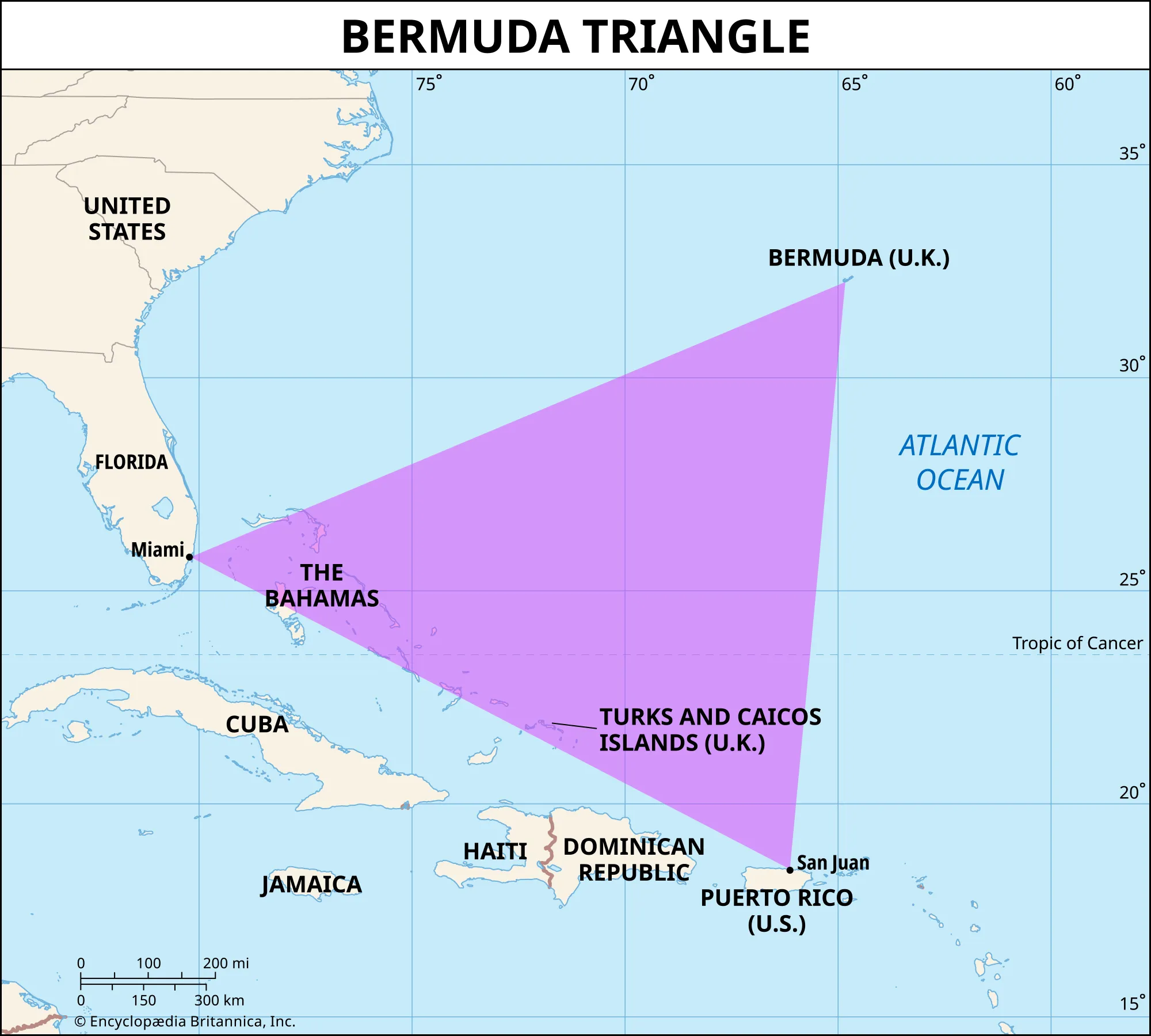
Somewhere between Miami, Bermuda, and Puerto Rico lies a stretch of ocean so notorious it has its own name, its own mythology, and its own section in every conspiracy bookshop on earth. The Bermuda Triangle. A place where, according to legend, ships vanish without trace, planes fall silent mid-transmission, compasses spin uselessly, and the laws of physics apparently take a day off.
Hundreds of vessels and aircraft have been claimed as its victims. Theories range from rogue waves to alien abductions, underwater methane explosions to time portals. It has been the subject of more books, documentaries, and breathless news segments than almost any geographical location on the planet.
There is just one problem. When you look at the actual data, the Bermuda Triangle may not exist at all — at least not as anything more than a very successful piece of publishing mythology. Here is the full story.
What We Know For Certain
- [FACT] The Bermuda Triangle is a loosely defined region of the North Atlantic Ocean, roughly bounded by Miami, Bermuda, and Puerto Rico — covering approximately 500,000 square miles.
- [FACT] The term “Bermuda Triangle” was first coined by writer Vincent Gaddis in a 1964 article in Argosy magazine.
- [FACT] Lloyd’s of London, the world’s leading insurance market, does not charge higher premiums for ships passing through the Bermuda Triangle — because their data shows no statistically elevated risk.
- [FACT] The US Coast Guard officially states it does not recognise the Bermuda Triangle as a particularly dangerous area of ocean.
- [FACT] The Bermuda Triangle is one of the most heavily trafficked shipping and aviation corridors in the world.
- [FACT] Many disappearances attributed to the Triangle occurred outside its actual boundaries, or involved vessels that were later found.
- [FACT] Tropical storms, hurricanes, and the Gulf Stream — all scientifically documented — regularly affect this region and can sink ships and destroy aircraft.
How the Myth Was Born
The Bermuda Triangle did not spring fully formed from the ocean. It was built, piece by piece, over several decades — mostly by writers who were better storytellers than fact-checkers.
[FACT] The first significant account linking the area to mysterious disappearances appeared in a 1950 article by journalist Edward Van Winkle Jones in the Associated Press. He noted several ships and planes had vanished in the region over the preceding years, though he offered no supernatural explanation.
It was Vincent Gaddis’s 1964 Argosy article — and Charles Berlitz’s enormously popular 1974 book The Bermuda Triangle — that truly launched the myth into the mainstream. Berlitz’s book sold 20 million copies worldwide. [FACT] It also contained numerous factual errors, misidentified locations, omitted cases where vessels were later found, and ignored the mundane explanations that investigators had already established.
Lawrence David Kusche, a librarian and pilot, spent years cross-referencing Berlitz’s claims against original records. His 1975 book The Bermuda Triangle Mystery — Solved found that many of the “mysterious” disappearances either never happened, occurred in different locations, took place in bad weather that Berlitz omitted, or had perfectly ordinary explanations. [FACT] In several cases, ships Berlitz claimed vanished in calm, clear conditions had actually sunk during storms.
The Famous Disappearances
Flight 19 — December 5, 1945
This is the case most closely associated with the Bermuda Triangle legend, and it is genuinely strange — though perhaps not for the reasons usually claimed.
[FACT] Five US Navy TBM Avenger torpedo bombers departed Fort Lauderdale Naval Air Station on a routine training mission and never returned. The flight leader, Lieutenant Charles Taylor, became disoriented and, believing he was over the Florida Keys, flew northeast — directly away from land and into open ocean. All 14 men aboard the five aircraft were lost. A rescue aircraft sent to search for them also disappeared, killing 13 more.
[FACT] The Navy’s own investigation concluded the most likely cause was navigational error by Taylor, who had requested not to be the lead navigator that day. His compass was also reportedly faulty.
[SPECULATION] Later accounts added details about strange radio transmissions, disoriented pilots reporting that the ocean “didn’t look right,” and suggestions of supernatural interference. Many of these details cannot be verified against the original radio logs and appear to have been embellished over time.
USS Cyclops — March 1918
[FACT] The USS Cyclops, a 542-foot US Navy collier carrying 10,800 tons of manganese ore, disappeared somewhere between Barbados and Baltimore with 309 crew and passengers aboard. No distress signal was sent. No wreckage was ever found. It remains the largest non-combat loss of life in US Naval history.
[FACT] The ship was known to be in poor mechanical condition, was overloaded, and was operating in an area of unpredictable weather. One of its engines was reportedly out of service. The captain, Georg Worley, was later described as erratic and possibly unfit for command.
[THEORY] Most naval historians believe the ship was simply overcome by severe weather and sank rapidly — taking all hands with it before anyone could send a signal. The lack of wreckage is explained by the Gulf Stream, which can carry debris thousands of miles from a sinking point.
Mary Celeste — 1872
[FACT] The brigantine Mary Celeste was found adrift in the Atlantic on December 4, 1872, fully seaworthy, with cargo intact, food on the table, and not a soul aboard. The ten people who had been on the ship — the captain, his wife, their daughter, and seven crew — were never found.
[FACT] The Mary Celeste was not in the Bermuda Triangle. It was found approximately 600 miles west of Portugal — thousands of miles from the Triangle’s boundaries. It is routinely included in Bermuda Triangle literature regardless.
[THEORY] The leading explanation, supported by physical evidence aboard the ship, is that the cargo of industrial alcohol may have produced fumes that convinced the captain a fire or explosion was imminent. The crew likely abandoned ship in a lifeboat and were lost at sea when the feared explosion never came.
The Leading Theories
Large deposits of methane hydrates exist on the ocean floor in the Bermuda Triangle region. Some scientists have theorised that sudden releases of methane gas could reduce water density enough to sink ships instantly, and that ignited gas clouds could bring down aircraft. [FACT] Laboratory experiments have demonstrated the sinking mechanism is physically possible. However, no confirmed methane eruption has been documented in the Triangle, and the theory remains unproven in this specific context.
The North Atlantic is known to produce rogue waves — massive, unpredictable walls of water that can reach 30 metres in height and appear without warning. [FACT] Rogue waves are a scientifically documented phenomenon and have been confirmed to sink large vessels. They leave little wreckage and no survivors to report what happened. This is considered one of the more credible mundane explanations for sudden ship disappearances in the region.
The Bermuda Triangle is one of only two places on earth — the other being the Devil’s Sea near Japan — where true north and magnetic north align, potentially confusing navigators using magnetic compasses. [FACT] This is a documented navigational fact. However, modern GPS navigation has made this largely irrelevant, and experienced navigators have always been trained to account for magnetic variation.
One of the more persistent fringe theories holds that the sunken city of Atlantis lies beneath the Bermuda Triangle, and that energy crystals used by the Atlanteans continue to interfere with modern navigation systems. This theory originates largely from the writings of psychic Edgar Cayce and has no archaeological or scientific support whatsoever.
A significant portion of Bermuda Triangle literature attributes the disappearances to alien abductions or underwater extraterrestrial bases. This theory has no credible evidence supporting it and is not taken seriously by mainstream science, aviation authorities, or naval investigators.
What Science Actually Says
[FACT] In 2013, the World Wide Fund for Nature identified the world’s most dangerous waters for shipping. The Bermuda Triangle was not among them. The most dangerous waters identified included the South China Sea, the Bay of Bengal, the Mediterranean, and the North Sea.
[FACT] A 2016 study by the Australian National University analysed Lloyd’s of London shipping data and found no statistically significant increase in disappearances within the Bermuda Triangle compared to other heavily trafficked ocean regions of similar size.
The scientific consensus is blunt: the Bermuda Triangle is not anomalous. Ships and planes disappear in every ocean on earth. The ones that disappear in the Bermuda Triangle are simply better known — because someone wrote a bestselling book about them in 1974 and the myth became self-sustaining.
Why the Myth Persists
The Bermuda Triangle should, by all rights, have been put to rest by Kusche’s meticulous debunking in 1975. It was not. The reason says more about human psychology than it does about ocean geography.
We are pattern-seeking animals. When ships vanish in the same broad region over a span of decades, we reach for a unifying explanation — even when the actual causes are varied, mundane, and thoroughly documented. A rogue wave, a navigation error, a faulty compass, a sudden storm — these are unsatisfying answers. A mysterious force that defies explanation is a far more compelling story.
The Bermuda Triangle also benefits from a feedback loop: the more famous it becomes, the more disappearances get attributed to it, which makes it more famous. Cases that occurred outside its boundaries get moved inside them. Cases with clear explanations get the explanations quietly omitted. The myth feeds itself.
[FACT] The name “Bermuda Triangle” does not appear in any official coastguard, navy, or aviation authority documentation as a designated hazard zone. It is a cultural phenomenon, not a geographical one.
Conclusion
The Bermuda Triangle is one of the most successful pieces of mass mythology in modern history. It is a testament to the power of a good story, a bestselling book, and humanity’s deep need to believe that the world contains forces beyond our understanding.
The disappearances it claims are real. The people lost in those waters were real. Their fates were tragic. But the evidence, examined honestly, points consistently toward mundane causes — weather, mechanical failure, human error, and the brutal indifference of the open ocean — rather than anything supernatural.
The Bermuda Triangle, as a zone of mysterious power, almost certainly does not exist. The North Atlantic, as a vast, dangerous, unpredictable body of water that has claimed thousands of vessels over centuries of human navigation, absolutely does.
Sometimes the truth is not that the ocean has a secret. Sometimes the truth is that the ocean is just the ocean — and the ocean is enough.
Written and reviewed by the MysteryVerse editorial team. All facts are sourced from documented historical records, official naval and coastguard reports, and peer-reviewed research. Theories and speculation are clearly labelled throughout.
Sources include: US Navy official records, Lloyd’s of London shipping data, Lawrence David Kusche’s The Bermuda Triangle Mystery — Solved (1975), Australian National University shipping analysis (2016), and US Coast Guard official statements.
If you spot an error, contact us and we will correct it promptly.