Estimated read time: 12 minutes | Category: Science Mysteries | Last updated: June 2025
The Explosion Nobody Investigated for 19 Years
At 7:17 AM on June 30, 1908, witnesses across a vast swathe of central Siberia saw a column of bluish light, nearly as bright as the sun, streak across the morning sky. Then came the explosion.
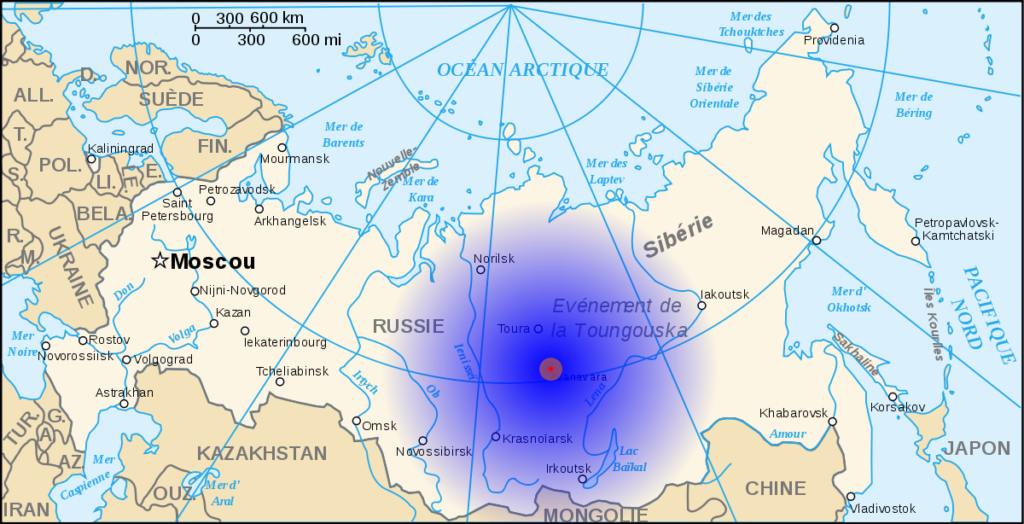
The blast was heard 800 kilometres away. The shockwave circled the Earth twice, registered on barometers as far away as England. Seismographs across the globe recorded what appeared to be an earthquake. A train on the Trans-Siberian Railway, hundreds of kilometres from the explosion, was reportedly halted by the shockwave. People were knocked off their feet at distances of 60 kilometres.
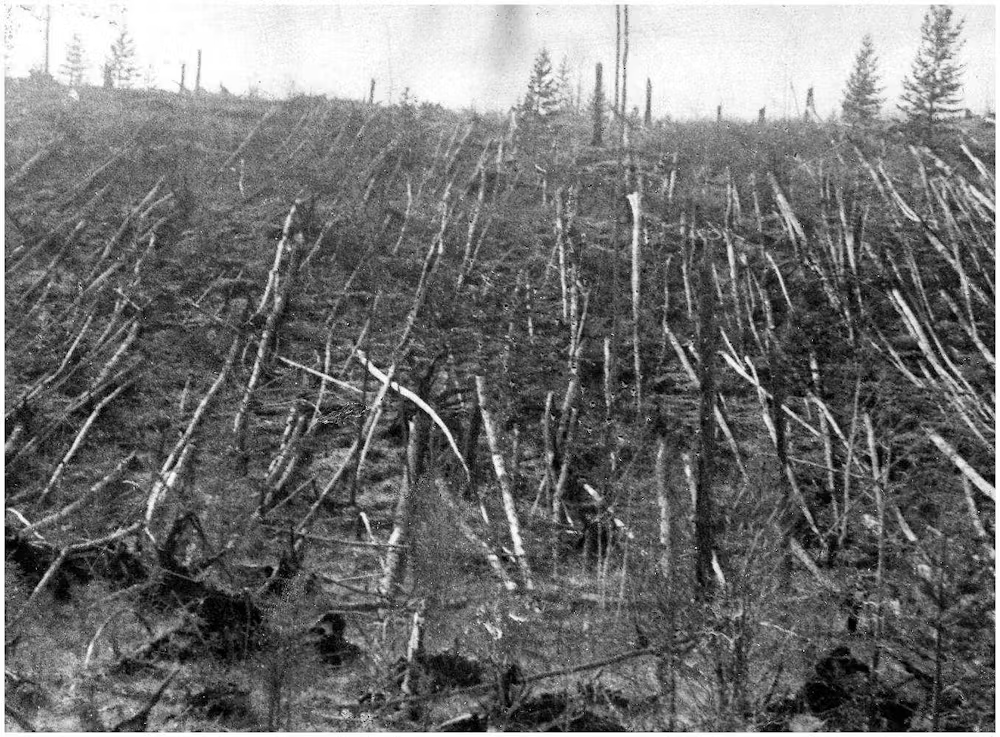
At ground zero, approximately 2,000 square kilometres of Siberian taiga — an area roughly the size of greater London — was flattened. Eighty million trees were felled, pointing outward from a central point like a vast radiating pattern of collapsed dominoes. Reindeer herds were incinerated. A trading post at Vanavara, 65 kilometres from the blast centre, had windows blown out and people thrown to the ground.
And then — almost nothing. No crater. No large fragments. No immediate scientific investigation. The region was so remote, and the Russian scientific establishment so preoccupied with other matters, that the first organised scientific expedition did not reach the Tunguska site until 1927 — nineteen years after the event.
The Tunguska event remains the largest impact event in recorded human history. And the full story of what caused it took nearly a century to piece together.
What We Know For Certain
- [FACT] On June 30, 1908, a large explosion occurred near the Podkamennaya Tunguska River in what is now Krasnoyarsk Krai, Russia, at approximately 60°N 102°E.
- [FACT] The explosion is estimated to have released energy equivalent to 10-15 megatons of TNT — approximately 185 times the energy of the Hiroshima atomic bomb, based on seismic and barometric records and tree fall pattern analysis.
- [FACT] Approximately 2,000 square kilometres of Siberian forest were flattened by the blast, with trees pointing radially outward from the explosion epicentre.
- [FACT] No impact crater was ever found at or near the epicentre of the explosion. This absence of a crater was the defining mystery of the Tunguska event for decades.
- [FACT] The first scientific expedition to the site, led by mineralogist Leonid Kulik, arrived in 1927 — 19 years after the event. Kulik conducted four expeditions to the site between 1927 and 1939.
- [FACT] The current scientific consensus holds that the Tunguska event was caused by the atmospheric airburst of a small asteroid or comet, which exploded before reaching the ground — explaining the absence of a crater and the pattern of destruction.
- [FACT] In 2013, a separate asteroid airburst event over Chelyabinsk, Russia — releasing energy estimated at 400-500 kilotons — provided the first modern recorded comparison event, helping scientists refine models of the Tunguska explosion.
The Morning of June 30, 1908
What Witnesses Saw and Felt
[FACT] The explosion occurred in one of the most sparsely populated regions on Earth — the central Siberian plateau — limiting the number of direct witnesses. Those who were present, however, left accounts that have been collected and analysed by researchers since the 1920s.
[FACT] The Evenki people indigenous to the region reported seeing a fireball brighter than the sun moving across the sky, followed by a tremendous explosion that knocked people from their feet, destroyed tents, and scattered reindeer herds. Several accounts described a wave of heat intense enough to burn skin at distances of tens of kilometres.
[FACT] At the trading post of Vanavara, 65 kilometres from the blast centre, trader Semyon Semyonov described being thrown from his porch by the explosion: “There was a bang in the sky and a mighty crash… My shirt almost burned on my back.” Semyonov’s account, recorded by Kulik in 1927, is one of the most frequently cited eyewitness testimonies.
[FACT] The explosion’s shockwave was recorded on barometers at meteorological stations across Europe and Asia. The seismic waves were recorded at stations as far away as Jena, Germany. Unusual atmospheric optical effects — bright nights, silvery clouds visible at unusually low latitudes — were reported across Europe and Russia in the days following the explosion, possibly due to dust and ice particles lofted into the upper atmosphere.
Leonid Kulik and the First Expeditions
[FACT] Leonid Kulik, a mineralogist at the Soviet Academy of Sciences, became the first scientist to seriously investigate the Tunguska event. He had encountered accounts of the explosion while reviewing old newspapers and meteorological reports, and mounted his first expedition to the site in 1927.
[FACT] The journey to the epicentre was extraordinarily difficult — the region had no roads, required weeks of travel by sledge and on foot through dense taiga, and the locals were reluctant to approach the blast area they associated with an angry god. When Kulik finally reached the epicentre, what he found both confirmed the scale of the destruction and deepened the mystery.
[FACT] The fallen trees extended for tens of kilometres in every direction, pointing outward from the blast centre. But at the very centre — where a crater should have been — there was no crater. The trees at the epicentre were still standing, though stripped of their branches. This “telegraph pole forest” at the blast centre, surrounded by millions of felled trees, was the most striking physical signature of an explosion that had occurred above the ground rather than at it.
[FACT] Kulik spent years searching for a crater and for meteoritic fragments, convinced that a massive meteorite must lie buried somewhere beneath the boggy ground. He drained boggy depressions in search of an impact site, finding nothing definitive. He conducted four expeditions between 1927 and 1939, none of which produced a satisfying explanation for the absence of a crater or the recovery of significant meteoritic material.
The Mystery of the Missing Crater
For decades, the absence of a crater at Tunguska was the defining puzzle of the event. A conventional meteorite impact of the energy implied by the explosion should have produced a crater several kilometres in diameter and scattered large fragments across the surrounding landscape. Neither was found.
[FACT] The solution to the crater mystery — now broadly accepted — is that the Tunguska object never reached the ground. Instead, it exploded in the atmosphere at an altitude of approximately 5-10 kilometres, converting its kinetic energy into a massive shockwave and thermal pulse that devastated the forest below without leaving a conventional impact crater.
[FACT] This type of event is now called an atmospheric airburst. When a rocky or icy object enters the atmosphere at high speed, the pressure on its leading face increases as the atmosphere becomes denser. If the object is not strong enough to withstand this pressure, it disintegrates explosively — releasing its energy in the atmosphere rather than at the ground. The pattern of destruction at Tunguska — the radially pointing fallen trees, the standing trees at the epicentre directly below the blast, the absence of a crater — is precisely what airburst models predict.
What Caused It — The Leading Theories
[FACT] The current scientific consensus, based on analysis of tree fall patterns, seismic records, lake sediment cores, and microscopic material recovered from the blast zone, is that the Tunguska event was caused by the atmospheric airburst of a small asteroid approximately 50-80 metres in diameter. The asteroid — composed of stony material — entered the atmosphere at high velocity and, unable to withstand the increasing atmospheric pressure, disintegrated explosively at an altitude of approximately 5-10 kilometres. The absence of a crater and the limited recovery of extraterrestrial material are consistent with a stony asteroid that was largely vaporised and pulverised in the airburst. Microscopic silicate and magnetite spherules recovered from peat bogs in the blast zone are consistent with melted and resolidified asteroid material.
For much of the 20th century, the leading theory was that the Tunguska object was the nucleus of a small comet rather than an asteroid. A comet nucleus — composed largely of ice, dust, and embedded rock — would be expected to disintegrate completely in an airburst, leaving no crater and no recoverable fragments, consistent with the Tunguska evidence. [FACT] However, analysis of microscopic material from the blast zone has found evidence more consistent with stony asteroid composition than with cometary material, and most researchers now favour the asteroid interpretation. The comet theory has not been definitively ruled out but is no longer the consensus view.
Over the decades, a variety of non-conventional explanations have been proposed for the Tunguska event, including an antimatter annihilation event, a miniature black hole passing through Earth, and the crash of an extraterrestrial spacecraft. [FACT] None of these theories is supported by the physical evidence. An antimatter annihilation would have produced a distinctive gamma-ray signature not recorded. A black hole transit would have produced a second explosion where it exited on the far side of the Earth — no such event was recorded. The spacecraft theory has no supporting physical evidence. These explanations are included here as part of the cultural history of the event, not as serious scientific alternatives.
The Chelyabinsk Event — A Modern Comparison
[FACT] On February 15, 2013, a small asteroid entered Earth’s atmosphere over the Russian city of Chelyabinsk and exploded in an airburst approximately 30 kilometres above the ground. The explosion — captured on dozens of dashcam videos and security cameras — released an estimated 400-500 kilotons of energy, injured approximately 1,500 people (mostly from shattered glass), and provided the first modern scientific opportunity to study a comparable event to Tunguska, albeit at much smaller scale.
[FACT] The Chelyabinsk event confirmed several key aspects of atmospheric airburst dynamics. The shockwave caused the majority of damage at ground level, consistent with Tunguska models. The asteroid — estimated at approximately 20 metres in diameter, compared to Tunguska’s estimated 50-80 metres — was not detected by any astronomical survey before its entry. This failure to detect a 20-metre object with significant damage potential highlighted the limitations of current asteroid detection programmes.
[FACT] Analysis of the Chelyabinsk event helped refine estimates of the Tunguska object’s size and composition, and provided calibration data for the mathematical models used to estimate Tunguska’s energy release. Scaling the Chelyabinsk event to the energy differential between the two explosions produces size estimates for the Tunguska object consistent with independent analyses.
What Would Happen If Tunguska Happened Today
[FACT] The Tunguska explosion occurred over one of the most remote and sparsely populated regions on Earth. Had the same event occurred over a major city, the consequences would have been catastrophic — the 2,000 square kilometre zone of total forest destruction would encompass most or all of many major urban areas.
[FACT] Comparative analysis: a Tunguska-scale airburst centred over London would flatten an area from the City to Heathrow Airport. Centred over New York, it would extend from Manhattan to well into New Jersey and Connecticut. The thermal pulse, which ignited fires across the Tunguska forest, would set fires across a much larger urban area than the direct blast zone.
[ANALYSIS] This hypothetical is not academic. The Chelyabinsk event demonstrated that even significantly smaller airbursts can cause significant casualties in populated areas — 1,500 injuries from a 500-kiloton event over a mid-sized Russian city. A Tunguska-scale event over any major population centre would be a catastrophe of historic proportions. Planetary defence — the scientific and engineering effort to detect, track, and potentially deflect asteroids that might threaten Earth — is driven in part by the Tunguska precedent.
Planetary Defence — The Legacy of Tunguska
[FACT] The Tunguska event is one of the primary motivations for the international effort to catalogue and track near-Earth objects. NASA’s Center for Near Earth Object Studies (CNEOS) and similar programmes worldwide systematically survey the sky for asteroids and comets whose orbits might bring them into proximity with Earth.
[FACT] Current catalogues track objects 140 metres in diameter and larger with reasonable completeness — objects in this size range would produce regional-scale devastation in an impact or airburst. Objects in the Tunguska size range (50-80 metres) are far less completely catalogued — the Chelyabinsk impactor was not in any catalogue before its arrival.
[FACT] NASA’s DART mission, which successfully deflected the asteroid Dimorphos in September 2022 by impacting it with a spacecraft, demonstrated for the first time that kinetic impactor technology can alter an asteroid’s orbit. This provides proof of concept for one potential planetary defence strategy — though deflection requires years of advance warning that current detection programmes cannot reliably provide for Tunguska-scale objects.
Conclusion
The Tunguska event happened at 7:17 AM on June 30, 1908, over a remote Siberian forest. It was the largest impact event in recorded human history. It flattened 2,000 square kilometres of trees, was heard 800 kilometres away, and sent shockwaves around the world. It left no crater. It killed no confirmed human casualties — because it happened in one of the most remote places on Earth.
A century of science has largely solved the central mystery: a stony asteroid approximately 50-80 metres across entered the atmosphere and exploded before reaching the ground, releasing energy equivalent to hundreds of Hiroshima bombs in a few seconds of atmospheric detonation. The forest below bore the consequences. The ground did not.
What the Tunguska event most powerfully illustrates is not a past mystery but a present reality: objects large enough to cause catastrophic damage arrive from space without warning and without a crater to announce them. The next Tunguska may come over a remote forest again. Or it may not.
Planetary defence exists because of June 30, 1908. Whether it will be adequate when it is needed is a question that deserves more urgency than it typically receives.
Written and reviewed by the MysteryVerse editorial team. Facts sourced from published research by Luca Gasperini et al. on Lake Cheko and Tunguska sediment analysis, Natalia Artemieva’s atmospheric entry modelling, NASA CNEOS documentation, published accounts from Leonid Kulik’s expeditions, and ESA/NASA documentation of the DART mission and Chelyabinsk event.
The Wikimedia Commons collection of Tunguska expedition photographs from the 1920s and 1930s is extraordinary — all public domain and highly recommended as article images.
Spotted an error? Contact us and we will correct it promptly.