Estimated read time: 12 minutes | Category: Science Mysteries | Last updated: June 2025
The Object That Rewrote History
In the spring of 1900, a group of Greek sponge divers were sheltering from a storm off the small island of Antikythera, between Crete and the Greek mainland. When the weather cleared, they dived on a nearby reef and found something extraordinary — an ancient Roman-era shipwreck lying at 45 metres, packed with bronze and marble statues, glassware, coins, and pottery.
The Greek government mounted a salvage operation. Over the following months, divers recovered one of the greatest collections of ancient artefacts ever found — including a corroded lump of bronze that nobody paid much attention to.
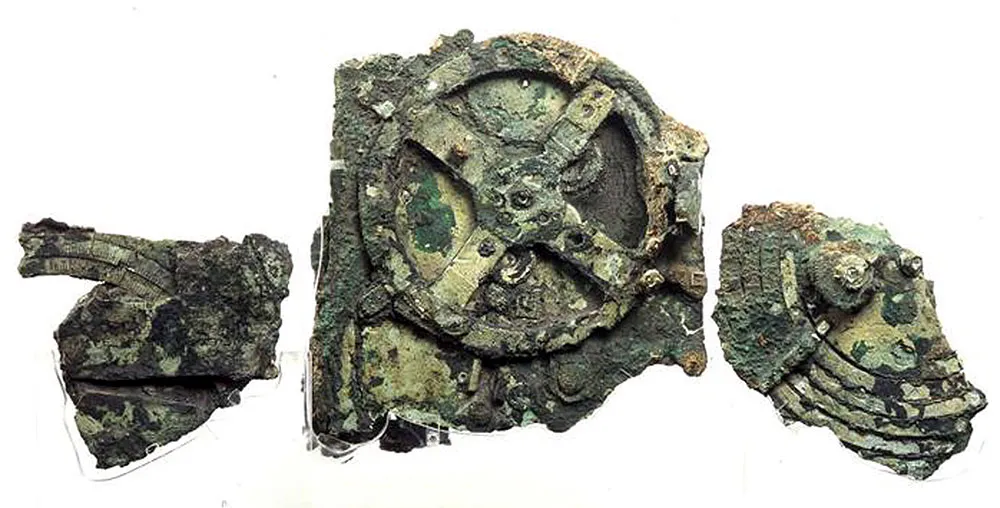
It sat in the National Archaeological Museum in Athens for two years. Then, in 1902, an archaeologist named Valerios Stais noticed that the corroded lump contained what appeared to be a gear wheel. He published his finding. Nobody believed him. The level of mechanical sophistication implied by a gear mechanism of that complexity — in an artefact dated to approximately 100-150 BCE — was considered impossible.
Stais was right. What he had identified was an astronomical computer of extraordinary sophistication — a device capable of predicting the positions of the Sun and Moon, tracking the Metonic cycle, predicting lunar and solar eclipses, and displaying the Greek calendar of athletic games — including the Olympics. It was built approximately 2,100 years ago. Nothing comparable in mechanical complexity would be built again for at least 1,400 years.
The Antikythera Mechanism is the most sophisticated technological artefact surviving from antiquity. And it has permanently changed our understanding of what ancient civilisations were capable of.
What We Know For Certain
- [FACT] The Antikythera Mechanism was recovered from an ancient shipwreck near the Greek island of Antikythera in 1900-1901. The ship is dated to approximately 70-60 BCE based on pottery and coin evidence, though the mechanism itself may have been built somewhat earlier.
- [FACT] The mechanism consists of at least 82 surviving fragments, the largest of which contain visible gear trains. It originally housed at least 37 interlocking bronze gears within a wooden case approximately the size of a shoebox.
- [FACT] X-ray analysis and advanced imaging have revealed that the mechanism could track the Metonic cycle (235 lunar months ≈ 19 solar years), predict solar and lunar eclipses using the Saros cycle, display the position of the Sun and Moon in the zodiac, and track the Greek Panhellenic Games calendar.
- [FACT] The mechanism’s front face displayed a zodiac dial and an Egyptian calendar dial. Its rear face showed two spiral dials — one for the Metonic cycle and one for the Saros eclipse prediction cycle.
- [FACT] Inscriptions on the mechanism — partially legible after advanced imaging — identify it as displaying the motions of celestial bodies and reference specific Greek place names, suggesting it was made in or for the Greek world, possibly on the island of Rhodes.
- [FACT] Nothing of comparable mechanical complexity is known to have been built in any culture until mechanical astronomical clocks appeared in Europe in the 14th century CE — a gap of approximately 1,400 years.
- [FACT] A 2021 study by University College London produced a complete computational model of the mechanism’s front panel, resolving several previously disputed elements of its design.
The Shipwreck and the Discovery
[FACT] The Antikythera shipwreck is one of the oldest known Roman-era shipwrecks in the Mediterranean. The vessel was carrying a cargo of extraordinary luxury goods — bronze and marble sculptures, glassware from Alexandria, fine pottery, coins, furniture, and what appear to have been personal possessions of wealthy passengers. The ship was probably travelling from the eastern Mediterranean toward Rome when it sank.
[FACT] The salvage operation of 1900-1901 was one of the first major underwater archaeological recoveries in history, conducted by sponge divers without modern equipment at depths that caused several cases of decompression sickness. The operation recovered an enormous quantity of material but was necessarily incomplete.
[FACT] The wreck site has been revisited multiple times since — most recently by the Return to Antikythera project using modern equipment. Additional mechanism fragments have been recovered, and researchers believe significant portions of the wreck remain unexcavated. Further fragments of the mechanism itself may still be on the seabed.
What the Mechanism Could Do
The full functional scope of the Antikythera Mechanism has been revealed gradually over more than a century of analysis — from early X-ray studies in the 1970s to the advanced CT scanning and polynomial texture mapping used in the Antikythera Research Team’s investigations from 2005 onward.
The Metonic Cycle
[FACT] The Metonic cycle — named after the 5th century BCE Greek astronomer Meton of Athens — is the observation that 235 lunar months equals almost exactly 19 solar years. After one Metonic cycle, the phases of the Moon recur on the same dates of the solar year. The mechanism tracked this cycle using a 235-tooth gear, allowing it to display the correspondence between lunar and solar calendars simultaneously.
Eclipse Prediction
[FACT] The mechanism’s rear lower spiral tracked the Saros cycle — a period of approximately 18 years and 11 days after which solar and lunar eclipses repeat in a similar pattern. By turning a dial through the Saros spiral, a user could predict when eclipses were likely to occur. The mechanism included glyphs indicating eclipse type — solar or lunar — and their approximate timing within a day.
The Planetary Motions
[FACT] The 2021 UCL study proposed a model for the mechanism’s front panel that incorporated the motions of all five planets visible to the naked eye — Mercury, Venus, Mars, Jupiter, and Saturn — in addition to the Sun and Moon. If confirmed, this would make the mechanism an even more sophisticated device than previously understood — a complete model of the known solar system as understood by ancient Greek astronomy.
[FACT] The planetary display used pin-and-slot mechanisms to reproduce the irregular apparent motions of the planets as seen from Earth — a sophisticated engineering solution to the problem of representing epicyclic motion mechanically.
The Games Dial
[FACT] One of the mechanism’s dials tracked the four-year cycle of the Greek Panhellenic Games — including the Olympic Games, the Pythian Games, the Isthmian Games, and the Nemean Games. This strongly suggests the mechanism was built for practical use by someone deeply embedded in Greek civic and religious life — the Games were among the most important events in the Greek world.
Who Built It and Why?
The identity of the mechanism’s maker — and the community of knowledge that produced it — is one of the most fascinating questions in the history of science.
The Rhodes Connection
[FACT] Multiple lines of evidence point to the island of Rhodes as the likely place of manufacture. The inscriptions on the mechanism reference stars and constellations as observed from a latitude consistent with Rhodes. The ancient writer Cicero described a mechanism built by the Stoic philosopher Posidonius of Rhodes — a contemporary of the mechanism’s estimated construction date — that could reproduce the motions of the Sun, Moon, and planets. Rhodes was one of the great centres of Greek astronomical and mathematical knowledge in the 2nd-1st centuries BCE.
Some researchers have connected the mechanism to the tradition of Archimedes of Syracuse — the 3rd century BCE mathematician and engineer who, according to ancient sources including Cicero, built mechanical models of the heavens. Cicero described seeing two such devices — one captured from Syracuse by Marcellus in 212 BCE. [THEORY] It is possible that the Antikythera Mechanism represents a tradition of astronomical mechanical modelling that began with Archimedes and was carried forward by subsequent Greek engineers whose identities have been lost. The specific maker of the recovered mechanism is unknown.
The Knowledge Required
[FACT] Building the Antikythera Mechanism required mastery of several advanced fields simultaneously: astronomical theory including the Metonic and Saros cycles, mathematical modelling of planetary motions, precision metalworking capable of cutting bronze gears with the required accuracy, and mechanical engineering knowledge to translate astronomical cycles into interlocking gear ratios.
[ANALYSIS] The existence of the mechanism implies a tradition of precision gear-cutting and mechanical engineering in the ancient Greek world that has left almost no other trace. Either the mechanism is an isolated genius achievement, or it represents the surviving example of a broader tradition of mechanical sophistication that was subsequently lost — possibly in the destruction of the Library of Alexandria, the Roman conquest of the Greek world, or simply the gradual loss of specialised knowledge over centuries of upheaval.
The Lost Technology Problem
The Antikythera Mechanism raises a question that historians of technology find deeply uncomfortable: if ancient Greeks could build this, why did the technology disappear?
[FACT] No other ancient gear mechanism of comparable sophistication has ever been found. There are ancient descriptions of mechanical devices — Heron of Alexandria described various automata and mechanisms in the 1st century CE — but no surviving physical examples that approach the Antikythera Mechanism’s complexity.
[THEORY] Several explanations have been proposed for the apparent disappearance of this technology:
- Rarity of surviving examples: Bronze was enormously valuable and was routinely melted down and reused throughout antiquity and the medieval period. The vast majority of ancient bronze objects — including any other gear mechanisms that may have existed — were destroyed for their metal value. The Antikythera Mechanism survived only because it was on a shipwreck at the bottom of the Mediterranean.
- Loss of specialised knowledge: The knowledge required to build such mechanisms may have been held by a small number of specialist craftsmen. The disruptions of the late Roman period, the economic contraction of late antiquity, and the collapse of the networks that sustained specialised knowledge transmission could have extinguished the tradition without leaving a written record.
- Different priorities: The Roman world that inherited Greek civilisation had different intellectual priorities — engineering for practical purposes (roads, aqueducts, military equipment) rather than astronomical modelling. The specific tradition of precision astronomical gear mechanisms may simply not have been valued and replicated by Roman patrons.
Some researchers have proposed that the Antikythera Mechanism was not a unique creation but one of a class of similar devices that were made in significant numbers in the Hellenistic world and simply have not survived. Under this reading, the mechanism’s sophistication reflects a broader technological capability that was more widespread than we currently understand — and its rarity in the archaeological record reflects the fragility of bronze objects rather than the rarity of such devices in antiquity. [SPECULATION] This is plausible but cannot be confirmed without additional archaeological evidence.
Modern Research — What We Are Still Learning
[FACT] The Antikythera Research Team’s project — using polynomial texture mapping and advanced CT scanning from 2005 onward — revealed approximately 3,500 characters of previously illegible text inscribed on the mechanism’s surfaces. This text — an instruction manual of sorts — has provided crucial information about the mechanism’s functions and construction.
[FACT] The 2021 UCL study, led by Professor Tony Freeth, used 3D computer modelling to produce the first complete proposed reconstruction of the mechanism’s front panel — resolving the planetary display question that had been debated for decades. The model demonstrated that all known gear fragments and inscriptions are consistent with a device displaying all seven celestial bodies known to ancient Greek astronomy.
[FACT] The UCL team built a physical model of the proposed front panel reconstruction using modern manufacturing techniques — demonstrating that the proposed gear arrangement is mechanically viable. This model is currently on display and has been widely exhibited.
[FACT] Ongoing excavation of the Antikythera wreck site continues. Researchers remain hopeful that additional mechanism fragments may be recovered from unexcavated portions of the wreck — fragments that could confirm or revise current understanding of the device’s full function.
Why the Antikythera Mechanism Matters
The Antikythera Mechanism matters for reasons that extend beyond its extraordinary engineering.
[ANALYSIS] It is a reminder that the history of human intellectual and technological capability is not a simple linear progression from primitive to sophisticated. Ancient peoples were not less intelligent than modern humans — they were equally intelligent, operating with different resources, different incentives, and different bodies of knowledge. The mechanism demonstrates that ancient Greek scientists achieved levels of astronomical understanding and mechanical engineering that we had, until its discovery, systematically underestimated.
[ANALYSIS] It also demonstrates the fragility of technological knowledge. The entire tradition of precision astronomical gear mechanisms — whatever its extent — was lost so completely that when medieval European craftsmen began building mechanical clocks in the 14th century, they did so without any known knowledge of the Antikythera tradition. Fourteen centuries of accumulated knowledge can disappear, leaving almost no trace. That is a sobering thought for any civilisation.
[FACT] The mechanism is currently housed in the National Archaeological Museum in Athens, where it is one of the most visited exhibits in the world. High-resolution digital scans of all fragments are publicly available through the Antikythera Research Team’s website — one of the most significant open access releases of archaeological data in history.
Conclusion
A corroded bronze lump recovered from a Mediterranean shipwreck in 1900 has, over more than a century of increasingly sophisticated analysis, revealed itself to be one of the most extraordinary objects ever made by human hands.
The Antikythera Mechanism was built approximately 2,100 years ago by craftsmen whose names we do not know, in a tradition whose extent we do not fully understand, for patrons whose identities remain unknown. It tracked the cosmos with a precision that would not be matched for fourteen centuries. It represented an entire branch of human technological achievement that was lost so completely that its rediscovery required learning to read an object we did not initially understand.
It is the most powerful physical argument against any assumption that the ancient world was technologically simple. And it sits in an Athens museum, waiting for the wreck it came from to give up whatever else lies in the unexcavated sediment of the Antikythera seabed.
There may be more fragments down there. There may be answers we have not yet found.
The mechanism has been teaching us things for 125 years. It may not be finished yet.
Written and reviewed by the MysteryVerse editorial team. Facts sourced from the Antikythera Research Team’s published papers including Freeth et al. (2006, 2008, 2021), the UCL Antikythera Research Team’s 2021 Nature study, the National Archaeological Museum Athens official documentation, and the Return to Antikythera project publications.
High-resolution scans of all Antikythera Mechanism fragments are publicly available at the Antikythera Research Team website. The UCL reconstruction model has been widely exhibited internationally.
Spotted an error? Contact us and we will correct it promptly.