Estimated read time: 12 minutes | Category: Unsolved Mysteries | Last updated: June 2025
The Book Nobody Can Read
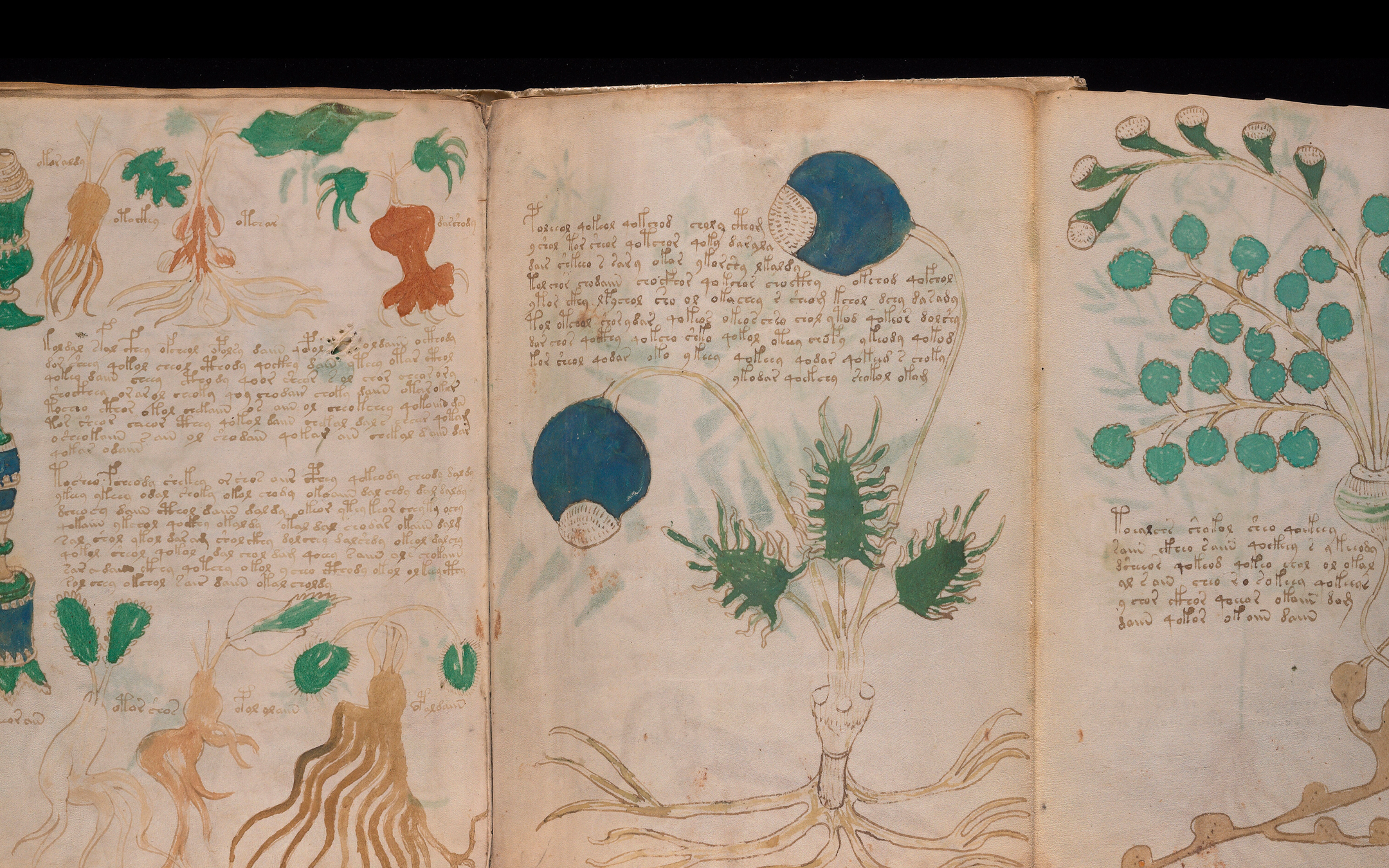
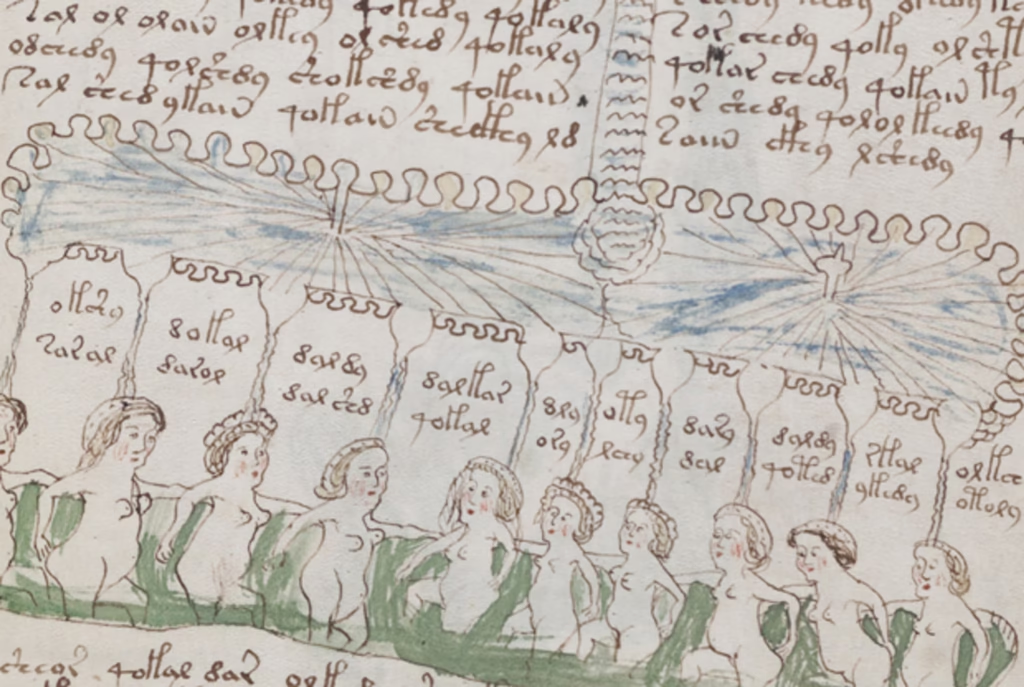
It sits in a climate-controlled vault at Yale University’s Beinecke Rare Book and Manuscript Library. It is 240 pages long — though researchers believe up to 32 pages may have been removed at some point in its history. Its pages are made of vellum, its ink has been carbon-dated to the early 15th century, and from its first page to its last it is covered in a flowing, elegant, completely unknown script accompanied by illustrations of plants that do not exist, astronomical diagrams that match no known system, and rows of bathing women connected by elaborate pipe networks whose purpose nobody has identified.
The Voynich Manuscript has been studied by professional cryptographers, amateur codebreakers, academic linguists, medieval historians, botanists, astronomers, and multiple artificial intelligence systems. It has been the subject of hundreds of academic papers, dozens of books, and more theories than almost any other document in human history.
Nobody has read a single word of it.
After more than a century of serious analysis, the Voynich Manuscript remains exactly what it was when it surfaced in 1912: a beautiful, baffling, completely impenetrable document that may be the most mysterious object in any library in the world.
What We Know For Certain
- [FACT] The Voynich Manuscript is named after Wilfrid Voynich, a Polish book dealer who purchased it in 1912 from the Jesuit College at Villa Mondragone in Frascati, Italy.
- [FACT] Carbon dating of the vellum, conducted by the University of Arizona in 2009, dated the manuscript’s material to between 1404 and 1438 — placing its creation in the early 15th century.
- [FACT] The manuscript contains approximately 170,000 characters written in an unknown script, organised into what appear to be words and sentences following consistent grammatical patterns.
- [FACT] Statistical analysis of the text shows it has properties consistent with natural language — including word frequency distributions that follow Zipf’s Law — rather than random character strings.
- [FACT] The manuscript is divided into sections that researchers have labelled: herbal, astronomical, biological, cosmological, pharmaceutical, and recipes — based on the accompanying illustrations.
- [FACT] The manuscript is currently held at Yale University’s Beinecke Rare Book and Manuscript Library, where it is catalogued as MS 408.
- [FACT] Despite analysis by professional World War II codebreakers, NSA cryptographers, university linguistics departments, and modern AI language models, no section of the text has been convincingly deciphered.
The Physical Object
[FACT] The manuscript measures approximately 23.5 by 16.2 centimetres — roughly the size of a modern paperback. Its pages are made of vellum, prepared from animal skin, of a quality consistent with early 15th century European manuscript production. The ink used for the text is a standard carbon-based ink of the period. The pigments used in the illustrations have been analysed and are consistent with European materials available in the early 1400s.
[FACT] The script runs left to right and is written in a fluid, practised hand — suggesting the author was thoroughly familiar with the writing system rather than laboriously constructing an invented alphabet. There are very few corrections or strike-throughs visible in the text, which researchers have interpreted as evidence that the writer was either copying from another source or writing in a system they knew well.
[FACT] The illustrations fall into several distinct categories. The herbal section — the largest — shows plants with roots, stems, leaves, and sometimes flowers or fruit, each accompanied by text that presumably describes or names them. The plants do not correspond to any identified species, though some bear passing resemblance to real plants in a stylised way. The astronomical section contains circular diagrams with zodiac symbols and what appear to be star maps. The biological section — one of the most discussed — shows many small female figures bathing in elaborate connected pools and channels, with text throughout.
The History of the Manuscript
The documented history of the Voynich Manuscript is almost as mysterious as its contents.
[FACT] The earliest confirmed owner whose identity we know is Georg Baresch, a 17th-century alchemist in Prague, who wrote to the Jesuit scholar Athanasius Kircher in 1639 asking for help deciphering the manuscript. Baresch described it as a book he had owned for many years, written in an unknown script, illustrated with strange plants and astronomical figures. Kircher — who was famous for his claimed ability to read Egyptian hieroglyphs — apparently never replied, or his reply has not survived.
[FACT] The manuscript passed to Jan Marek Marci, rector of Charles University in Prague, who sent it to Kircher in 1666 with a letter stating that the book had previously been purchased by Holy Roman Emperor Rudolf II for 600 gold ducats — an enormous sum suggesting Rudolf believed it to be something extraordinary. Rudolf was known for his obsessive collection of curiosities, alchemical texts, and claimed magical objects.
[FACT] The manuscript appears to have remained in Jesuit collections until Wilfrid Voynich purchased it in 1912. Voynich recognised its extraordinary nature immediately, made photographic copies, and began circulating them among scholars in the hope that someone could identify the script or language. Nobody could.
[FACT] Voynich’s widow sold the manuscript after his death to a rare book dealer, from whom it was purchased by Hans P. Kraus, who donated it to Yale University in 1969, where it has remained ever since.
The Language — What the Statistics Show
One of the most significant and debated aspects of the Voynich Manuscript is what statistical analysis of the text reveals — and what it does not.
[FACT] The text exhibits what linguists call Zipf’s Law distribution — a statistical pattern found in virtually all natural human languages, in which a small number of words appear very frequently and a large number of words appear rarely. This is not a property of random character strings or simple substitution ciphers, which typically show more uniform distributions.
[FACT] The text also shows consistent word-level patterns: certain character sequences appear frequently at the beginnings of words, others at the ends, and others only in the middle — consistent with the morphological rules of natural languages. Certain words appear to repeat in ways consistent with grammatical function words in natural language.
[FACT] However, the Voynich text also shows some unusual properties that distinguish it from known natural languages. Its entropy — a measure of information density — is lower than most natural languages, meaning it is more repetitive than typical human writing. Some researchers have argued this suggests the text encodes information through a more complex system than simple letter substitution.
The most straightforward interpretation of the statistical evidence is that the Voynich Manuscript contains a real natural language — one that has not been identified — written in a script invented specifically for it. This could be a now-extinct language, a regional dialect that was never widely written, or a language from a geographic area whose written traditions have not survived for comparison. If correct, decipherment would require finding a bilingual key — a Rosetta Stone equivalent — that connects the Voynich script to a known language.
The Leading Theories
Many researchers believe the manuscript encodes a known European language — possibly Latin, Italian, German, or Hebrew — through a complex encryption system. The early 15th century saw significant interest in cryptography among European scholars, alchemists, and diplomats. If the Voynich script is a cipher rather than a natural alphabet, the statistical properties of the text would reflect the underlying language’s patterns, which could explain the Zipf’s Law distribution. This theory has produced many claimed decipherments — none of which have been accepted by the broader research community.
Some researchers have proposed that the Voynich Manuscript was written in an entirely invented language — a philosophical language constructed by its author to represent ideas or knowledge in a system of their own devising. Artificial language construction was a subject of serious intellectual interest in the medieval and early modern period. If the manuscript is an artificial language, its decipherment would be extremely difficult without the key, as there would be no related natural language to use as a reference point.
Steganography — hiding messages within apparently innocent content — was practised in the medieval period. Some researchers have proposed that the Voynich script is itself meaningless, but that the real message is encoded in subtle features of the illustrations, the positioning of characters, or the spacing of words. Under this theory, the apparent linguistic properties of the text are an elaborate red herring. This theory is difficult to test because it requires knowing what steganographic system to look for.
A significant minority of researchers — including some with strong academic credentials — have argued that the Voynich Manuscript is an elaborate medieval hoax: a book of impressive-looking but entirely meaningless text, designed to be sold to a wealthy collector like Rudolf II who would pay handsomely for what he believed to be an ancient magical or alchemical text. Under this theory, the statistical properties that resemble natural language are either coincidental or were deliberately engineered to fool buyers. [FACT] Computer scientist Gordon Rugg demonstrated in 2004 that the Voynich text’s statistical properties could be replicated using a simple 16th-century tool called a Cardan grille — supporting the possibility of a sophisticated hoax. However, the hoax theory does not explain why the manuscript was maintained and preserved for centuries without anyone exposing it.
Fringe theories have proposed that the Voynich Manuscript originates from an extraterrestrial source, from the lost civilisation of Atlantis, or from an advanced prehistoric human culture. These theories are not supported by the physical evidence — the carbon dating, the ink composition, the vellum preparation, and the illustration style all point clearly to early 15th century European origin. They are included here because they form part of the cultural conversation around the manuscript.
The Failed Decipherments
The history of Voynich decipherment attempts is long and largely dispiriting — a graveyard of confident announcements followed by quiet retreats.
[FACT] William Friedman, one of the greatest cryptanalysts in American history and the man who broke the Japanese PURPLE cipher in World War II, spent years working on the Voynich Manuscript. He concluded it was likely an artificial philosophical language but was never able to produce a convincing decipherment.
[FACT] In 2019, researcher Gerard Cheshire published a paper in the journal Romance Studies claiming he had deciphered the manuscript as a form of proto-Romance language. His claimed decipherment was rapidly and comprehensively rejected by linguists and Voynich researchers, who found his translations inconsistent and unsupported by the text.
[FACT] In 2017, a team of Canadian computer scientists applied AI language analysis to the Voynich text and concluded it was most statistically similar to Hebrew written without vowels — a method of writing called scriptio defectiva. Subsequent attempts to use this finding as a basis for full decipherment have not produced convincing results.
[FACT] As of 2025, no proposed decipherment of the Voynich Manuscript has achieved consensus acceptance among the academic community. The manuscript remains undeciphered.
What Modern Technology Has Revealed
While decipherment has remained elusive, modern scientific analysis has significantly expanded what we know about the manuscript’s physical properties.
[FACT] Multispectral imaging of the manuscript’s pages has revealed traces of text that was erased or covered in some sections, suggesting the manuscript was reworked or edited at some point in its creation.
[FACT] Analysis of the quill strokes and ink flow suggests the text was written by at least two different scribes — possibly more — raising questions about whether the manuscript was a collaborative work or was continued after its original author’s death.
[FACT] Detailed botanical analysis of the plant illustrations has identified structural features — root systems, leaf venation patterns, flower arrangements — that appear botanically consistent with real plants, even where the overall appearance does not match any known species. Some researchers interpret this as evidence the illustrator was drawing from real botanical specimens in a heavily stylised manner.
Why It Matters
The Voynich Manuscript matters beyond its mystery status for several reasons.
If it encodes a real language, deciphering it could reveal significant knowledge from the early 15th century — whether medical, botanical, astronomical, or alchemical — that is currently completely inaccessible. The manuscript appears to be a serious work of knowledge organisation, not a decorative object. Whatever it says, someone thought it important enough to write at great length and illustrate extensively.
If it is a hoax, understanding how and why it was created illuminates the intellectual culture, the commercial practices, and the epistemological vulnerabilities of medieval Europe in ways that have genuine historical value.
And if it remains permanently undeciphered — which is a real possibility — it stands as a uniquely humbling reminder of the limits of human knowledge. We have put rovers on Mars, mapped the human genome, and modelled the formation of galaxies. We cannot read a book that a person wrote by hand six hundred years ago.
Conclusion
The Voynich Manuscript sits in its vault at Yale, photographed, digitised, distributed freely online, studied by thousands of researchers across six centuries — and still completely silent.
It may be a language we have never encountered. It may be a cipher we have not broken. It may be a hoax sophisticated enough to fool everyone who has ever looked at it. It may be a private notation system whose key died with its author. It may be something none of the existing theories has yet imagined.
What it is not is random. The statistical properties are too consistent, the illustrations too deliberate, the construction too careful. Someone made this, and they made it to mean something.
We just cannot hear them yet.
Written and reviewed by the MysteryVerse editorial team. Facts sourced from Yale University Beinecke Library official records, University of Arizona carbon dating study (2009), published academic research in cryptography and linguistics, and the Voynich Manuscript Research Group’s documented findings.
The full Voynich Manuscript has been digitised and is freely available online at the Beinecke Digital Collections: beinecke.library.yale.edu
Spotted an error? Contact us and we will correct it promptly.